Patients are often surprised to hear that the problem standing between them and an implant is not the missing tooth but the bone underneath it. The jaw is living tissue that responds to use, and once a tooth goes the bone that held it begins to shrink. What is jaw bone loss is therefore one of the first things we explain at an implant consultation, because it shapes almost every decision that follows.
This article covers why the jaw loses volume, how quickly it happens, what the signs are and how the loss is measured on a scan. It then looks at the treatment routes that remain open, from grafting to implants that avoid the weakest bone altogether. Anyone asking what is jaw bone loss should come away knowing that it is common, measurable and, in most cases, still treatable.
Don't Delay Your Treatment
Let's create your personalised treatment plan right away with a complimentary consultation with our specialist dentists.
Table of Contents
What is jaw bone loss?
What is jaw bone loss in plain terms is the gradual shrinking of the bone that once held a tooth root. Bone stays dense only while it is loaded, and a tooth root loads the jaw every time you bite. When the root is gone the stimulus goes with it, and the body starts to resorb the unused bone. The ridge becomes lower and narrower, first quickly and then more slowly over years.
- Tooth loss is the most common trigger, and the loss starts within weeks of an extraction.
- Gum disease destroys bone around teeth that are still present.
- Long term denture wear presses on the ridge and accelerates shrinkage.
- Trauma, infection and some medical conditions can also reduce bone volume.
The amount of loss varies widely between patients, which is why what is jaw bone loss has no single answer. Some keep a good ridge for decades, others lose a large share of the original height within a few years. Genetics, gum health, smoking and how long the gap has been empty all play a part. That is why two patients with the same missing tooth can need very different treatment plans.
How quickly does the jaw shrink after a tooth is lost?
The fastest change happens in the first year. Studies of extraction sockets show that a large part of the ridge width can be lost within six to twelve months, with the outer wall of bone shrinking first. After that the process continues at a slower pace, but it does not stop. A gap left for ten years usually has noticeably less bone than one left for one year.
This timing is the reason implant surgeons prefer to plan replacement early. Placing an implant soon after extraction, or preserving the socket with a small graft at the time of removal, keeps much of the bone that would otherwise disappear. What is jaw bone loss in practice is often a story of time, and time is the one factor a patient can influence by not delaying the decision. Our article on how soon after tooth extraction you can get an implant explains the ideal window.
What are the signs of bone loss in the jaw?
Early bone loss is silent, which is why it is usually found on an X-ray rather than felt by the patient. Knowing what is jaw bone loss helps patients recognise the later signs sooner. As it progresses the signs become visible. Dentures that once fitted well start to loosen and need relining. The lower face can look shorter and the lips less supported, giving an older appearance. Remaining teeth may drift or feel loose as their support diminishes.
Don't Delay Your Treatment
Let's create your personalised treatment plan right away with a complimentary consultation with our specialist dentists.
In the upper back jaw the sinus expands downward into the space the roots once occupied, which leaves very little bone height for an implant. In the lower jaw the nerve canal comes closer to the surface. What is jaw bone loss looks like on the outside is subtle, but on a scan these changes are clear and they decide which implant technique is possible.
How is jaw bone loss measured?
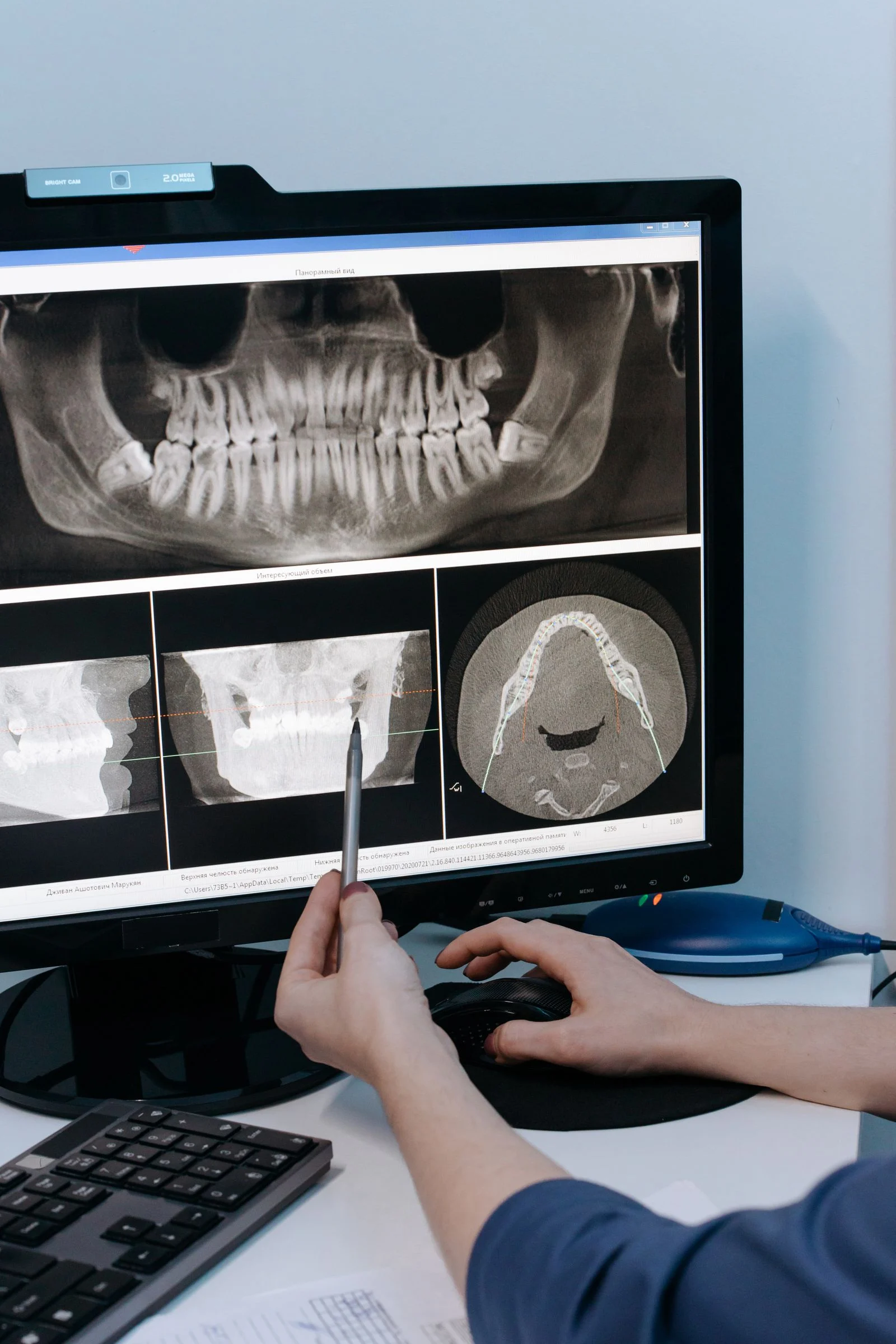
A panoramic X-ray gives a first impression of bone height, but the decisive tool is a cone beam CT scan. It shows the ridge in three dimensions, so the surgeon can measure height, width and density at the exact spot where an implant would go. It also maps the sinus floor and the nerve canal, the two structures that limit implant length in the upper and lower jaw.
From the scan the surgeon classifies the ridge and decides whether a standard implant will fit, whether the site needs grafting first, or whether an alternative design should be used. This is why we never quote a full plan from photographs alone. What is jaw bone loss for one patient may be a minor width deficit that a small graft solves, and for another a severe height loss that changes the whole approach. Our bone graft & sinus lift page explains the procedures that follow from these measurements.
Can bone loss in the jaw be reversed?
Lost bone does not grow back on its own, but it can be rebuilt, and that is the reassuring half of what is jaw bone loss. Bone grafting places natural or synthetic material into the deficient area and covers it with a membrane, and over several months the body converts it into living bone. In the upper back jaw a sinus lift raises the sinus floor and fills the space with graft to restore height. Both procedures are routine in implant surgery.
Grafting adds time to the treatment, typically four to six months of healing before an implant can be placed, or longer for larger reconstructions. The trade off is a stable, long lasting foundation. We describe the surgery itself in what happens during a bone graft and compare the two main procedures in bone graft or sinus lift. Understanding what is jaw bone loss makes these procedures easier to accept, because they address the cause rather than working around it.
Don't Delay Your Treatment
Let's create your personalised treatment plan right away with a complimentary consultation with our specialist dentists.
Can you have implants with jaw bone loss?
In most cases yes. Mild and moderate loss is handled with grafting or with implants placed at an angle to reach the denser bone that remains. Full arch protocols such as All-on-4 are designed around this idea, using the front of the jaw where bone lasts longest and tilting the back implants to avoid the sinus and the nerve. Many patients who were told they had no bone are candidates for this approach.
- Standard implants with a graft when the deficit is small and localised.
- Angled or shorter implants that use the bone that remains without grafting.
- All-on-4 or All-on-6 for a full arch built on the strongest available bone.
- Zygomatic implants anchored in the cheekbone for severe upper jaw loss.
Which route is right depends on the scan and on how much time the patient can commit. Zygomatic implants avoid grafting entirely and allow a fixed bridge within days, which is why they suit patients travelling from abroad. What is jaw bone loss stops being a barrier once the measurements are known, because each level of loss has a matching technique. Our zygomatic dental implants page covers the most advanced of these options, and our dental implants page in Istanbul outlines how each plan is built.
What is jaw bone loss going to mean for a patient travelling for treatment?
For a patient flying in, bone loss mainly changes the schedule. A simple case can often be completed in two visits, but a case needing a graft usually adds a healing period between the graft and the implant, which can mean an extra trip or a longer gap between the two. Zygomatic and All-on-4 protocols were developed partly to avoid that delay, which is why they are so common among international patients. The scan should be taken before any dates are booked so that the number of visits is known in advance. A clinic that plans the timeline around the scan, rather than around the flight, is treating the bone loss seriously.
What is jaw bone loss and does everyone get it after losing a tooth?
It is the shrinking of the bone that held the tooth root. Everyone loses some bone after an extraction, but the amount and speed vary between patients.
Does jaw bone loss hurt?
Can jaw bone loss be prevented?
It can be slowed. Replacing a lost tooth early with an implant, or preserving the socket at extraction, keeps the bone loaded and limits shrinkage.
Do I need a bone graft before implants?
Not always. Angled implants, All-on-4 and zygomatic implants can work with existing bone. The CT scan decides which option fits.